
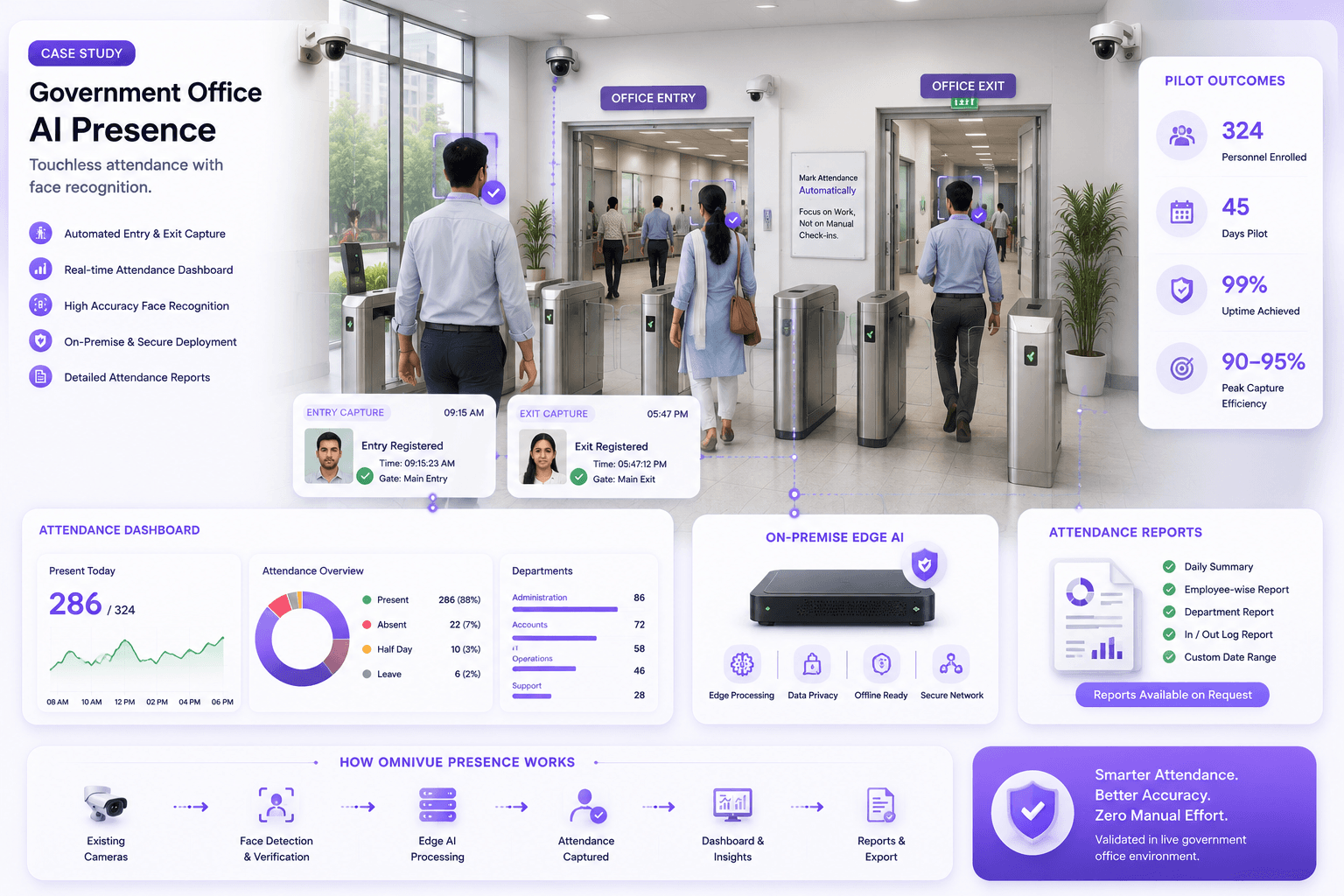
AI presence validation for a live government office environment.
Omnivue Presence was piloted at the Directorate of Public Instruction, Bhopal to validate passive face-recognition attendance, real-time presence visibility, dashboard reporting and scalability for government offices and educational institutions.
324
personnel enrolled
On-site enrollment during pilot
45
pilot days
Controlled validation period
99%
system uptime
Stable operation during pilot
Presence
Attendance capture
Edge AI
Local processing
Dashboard
Daily reports
Governance
Audit-ready logs
Operational challenge
Government attendance needs visibility without disrupting daily movement.
The pilot was designed to test real-world attendance capture in a natural office environment where staff move through entry and exit points without stopping for a dedicated biometric punch.
Manual or semi-manual attendance processes can be difficult to audit at scale.
Peak entry periods create burst movement, group entry and limited pause time in camera zones.
Presence and attendance disputes require objective records instead of retrospective CCTV review.
Government offices need visibility without adding friction or forcing staff to stop at a device.
Validation summary
Live pilot metrics from a passive attendance environment.
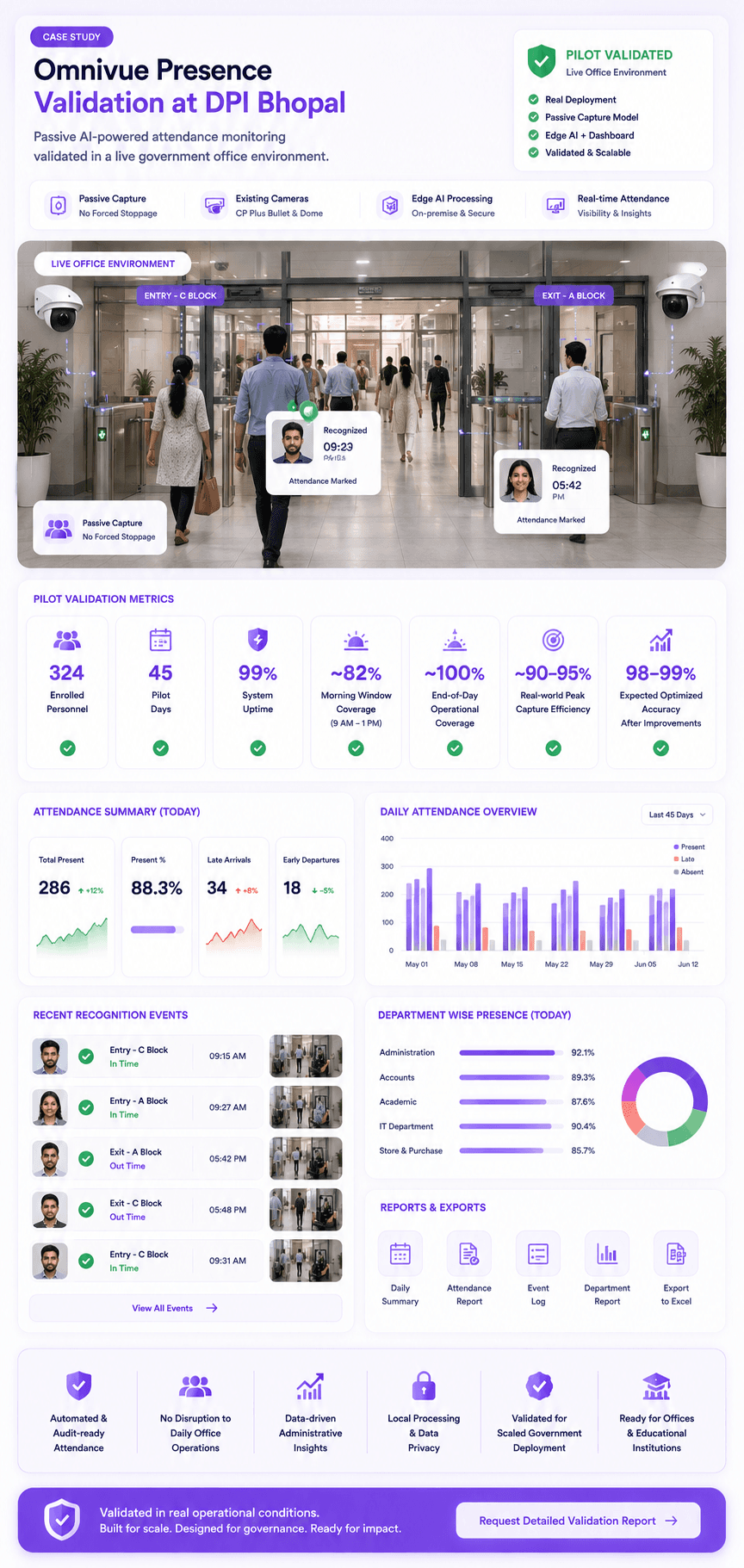
The pilot validated attendance capture under real operating conditions, including burst entries, group movement, partial face visibility and distributed movement later in the day.
Morning window coverage
Observed during 9 AM to 1 PM peak entry window in a natural, non-controlled movement environment.
~82%
pilot metric
End-of-day operational coverage
Most people missed during congested peak periods were captured later during distributed movement.
~100%
pilot metric
Real-world peak capture efficiency
Measured under live office conditions with passive camera capture and no forced stoppage.
~90–95%
pilot metric
Optimized deployment pathway
Expected operational accuracy range with capture-zone optimization, improved enrollment and optional dual-angle capture.
98–99%
pilot metric
Deployment approach
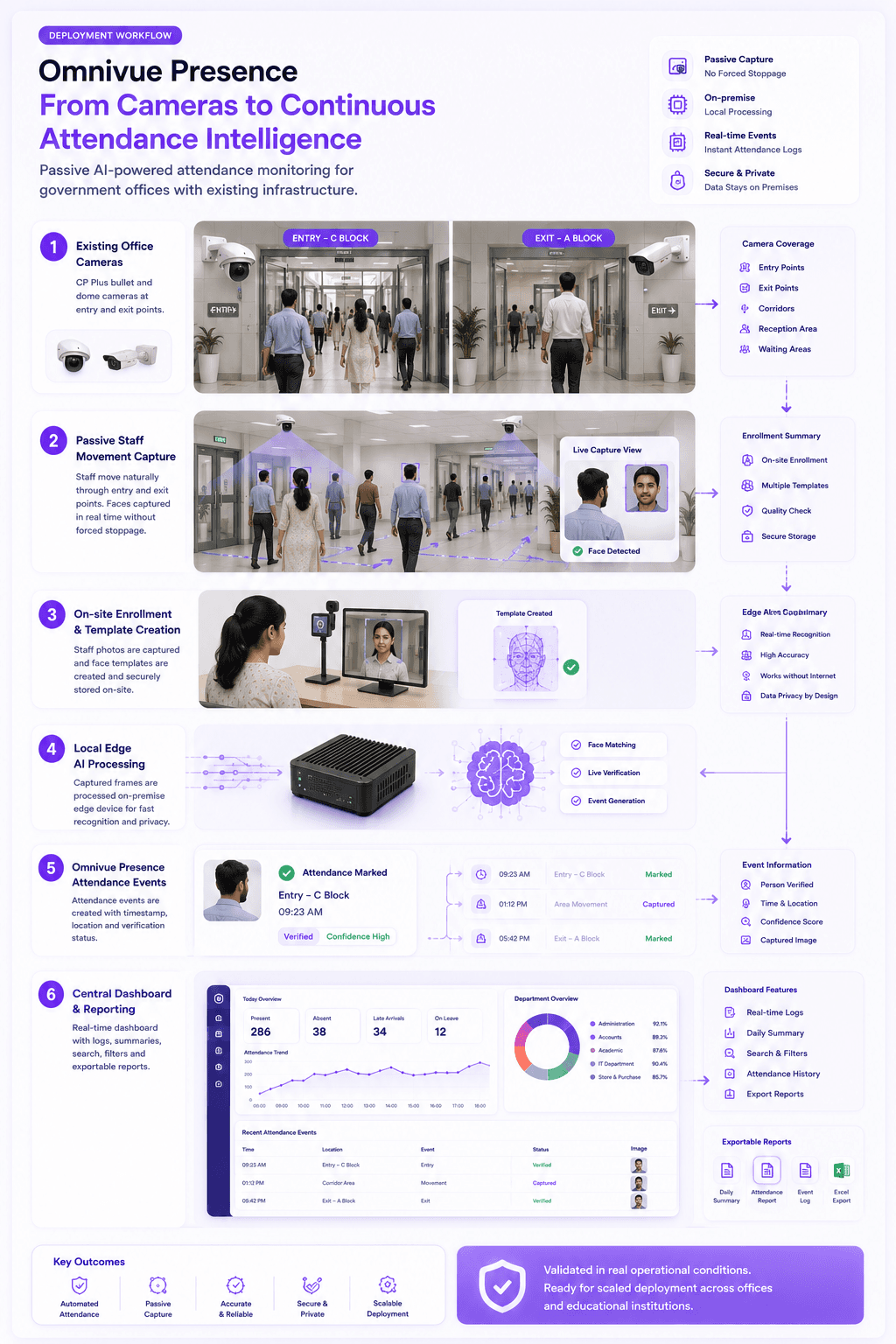
Existing office cameras became a real-time attendance and presence layer.
The deployment used existing CP Plus cameras, passive capture, on-site enrollment and an edge-processing architecture connected to a central attendance dashboard.
Step 1
Existing camera infrastructure used
CP Plus bullet varifocal and dome cameras were used at Entry/Exit C Block and Entry/Exit A Block.
Step 2
Passive capture configured
Staff movement was captured naturally without forced stoppage, biometric punching or manual check-in behavior.
Step 3
Edge processing with central dashboard
Recognition and attendance event processing were handled through an edge-processing architecture with central dashboard visibility.
Step 4
Attendance logs and reports generated
The dashboard provided real-time attendance logs, daily summaries, recognition event logs, searchable history and exportable reports.
Administrative intelligence
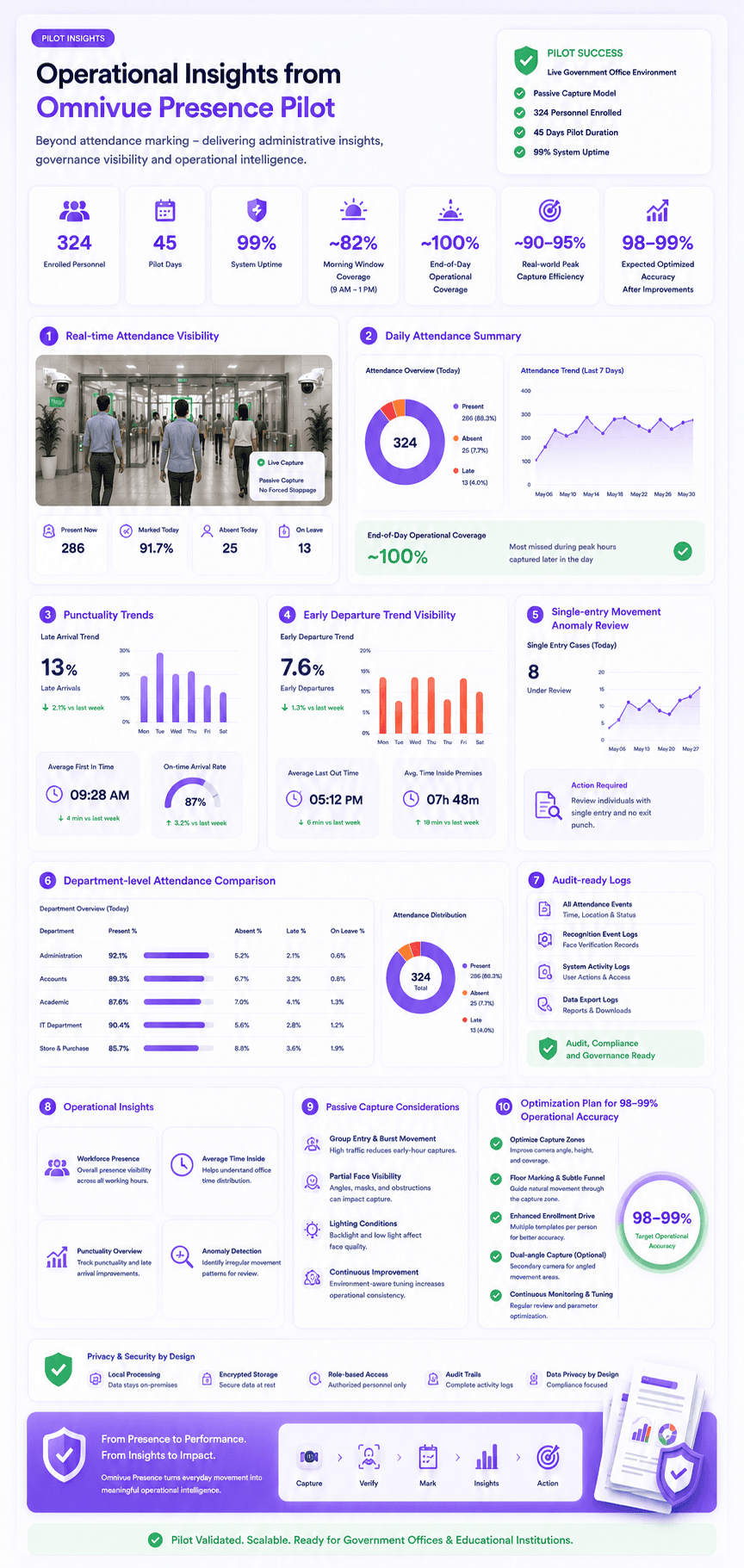
Beyond marking attendance, the pilot surfaced workforce presence trends.
The pilot demonstrated how passive attendance data can support administrative analysis, punctuality monitoring and anomaly review without positioning the system as payroll-grade enforcement in uncontrolled capture environments.
Real-time attendance visibility
Automatic attendance consolidation, daily status visibility and centralized reporting for administrative teams.
Punctuality trend analysis
Late arrival trends and department-level comparisons can support governance review and administrative planning.
Movement anomaly detection
Potential early departure and single-entry movement patterns can be surfaced for review without manual log reconciliation.
Audit-ready presence records
Presence logs, recognition event records and attendance reports improve transparency and reduce manual errors.
Rollout readiness
The pilot identified a clear path to stronger operational consistency.
The report concluded that the system did not fail during missed peak captures. Instead, variance was caused by real-world operational factors such as group entry, non-frontal face presentation, lighting and natural walking speed.
Controlled entry capture zone
Floor marking, subtle funneling, optimal camera alignment and face-level lighting can reduce peak-hour variance.
Enhanced enrollment drive
Re-enrollment of low-quality images and 2–3 templates per person can improve recognition stability.
Optional dual-angle capture
A secondary camera can help in locations where angled movement or partial face visibility is common.
Scaled phased rollout
Expanded pilot offices, cluster deployment and district-level dashboards can support controlled scaling.
Outcomes observed
The pilot validated Omnivue Presence for structured government attendance monitoring.
Operational feasibility validated
The pilot demonstrated that automated face-recognition attendance is feasible in a live government office environment.
Passive capture limitations understood
The pilot separated algorithm performance from real-world factors such as group entry, non-frontal faces, lighting and walking speed.
Government-scale roadmap established
The report identified a phased pathway for broader rollout across offices, schools and district-level dashboards.
Governance and privacy fit documented
The deployment model included local processing, encrypted storage, role-based access and audit logs.
Detailed validation report
Public case study here. Detailed pilot report available on request.
This public page avoids exposing raw internal validation documents, personal data, detailed staff records or operational screenshots. Qualified buyers and partners can request the detailed report for deeper technical and governance review.
Pilot location, deployment type and module scope
Enrollment count, pilot duration and key performance metrics
Camera setup, passive capture model and dashboard capability
Peak-hour and end-of-day accuracy analysis
Advanced workforce analytics and governance insights
Optimization plan for structured rollout
Privacy, security and data governance considerations
Scalability roadmap for offices and educational institutions
Best fit for
Government offices, schools, colleges and distributed public institutions.
This deployment pattern is relevant where attendance needs to be captured passively from existing entry and exit camera coverage while maintaining local processing and administrative control.
Related Omnivue pages
Explore related solutions, industries and modules.
Want to validate AI attendance at your institution?
Share your entry points, camera coverage, staff movement flow and reporting needs. We can help map the right Omnivue Presence deployment and pilot scope.