
AI safety monitoring for warehouse HSE operations.
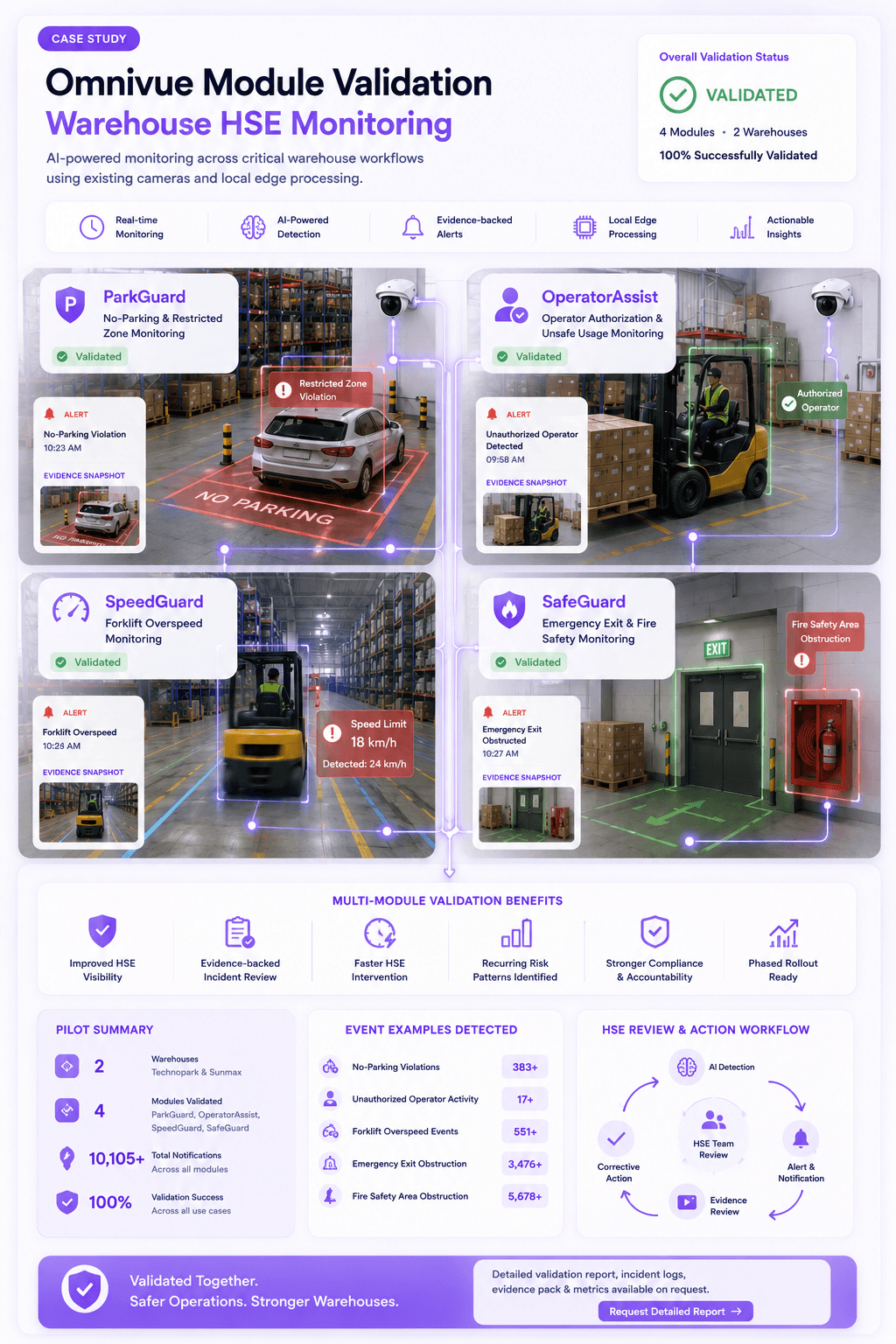
Omnivue was validated across Danube warehouse environments to monitor restricted parking, operator compliance, forklift overspeeding and emergency/fire safety obstruction using existing camera infrastructure and local edge processing.
2
warehouse facilities covered
Technopark and Sunmax
4
Omnivue modules validated
ParkGuard, OperatorAssist, SpeedGuard, SafeGuard
On-premise
deployment model
Local edge processing with existing camera infrastructure
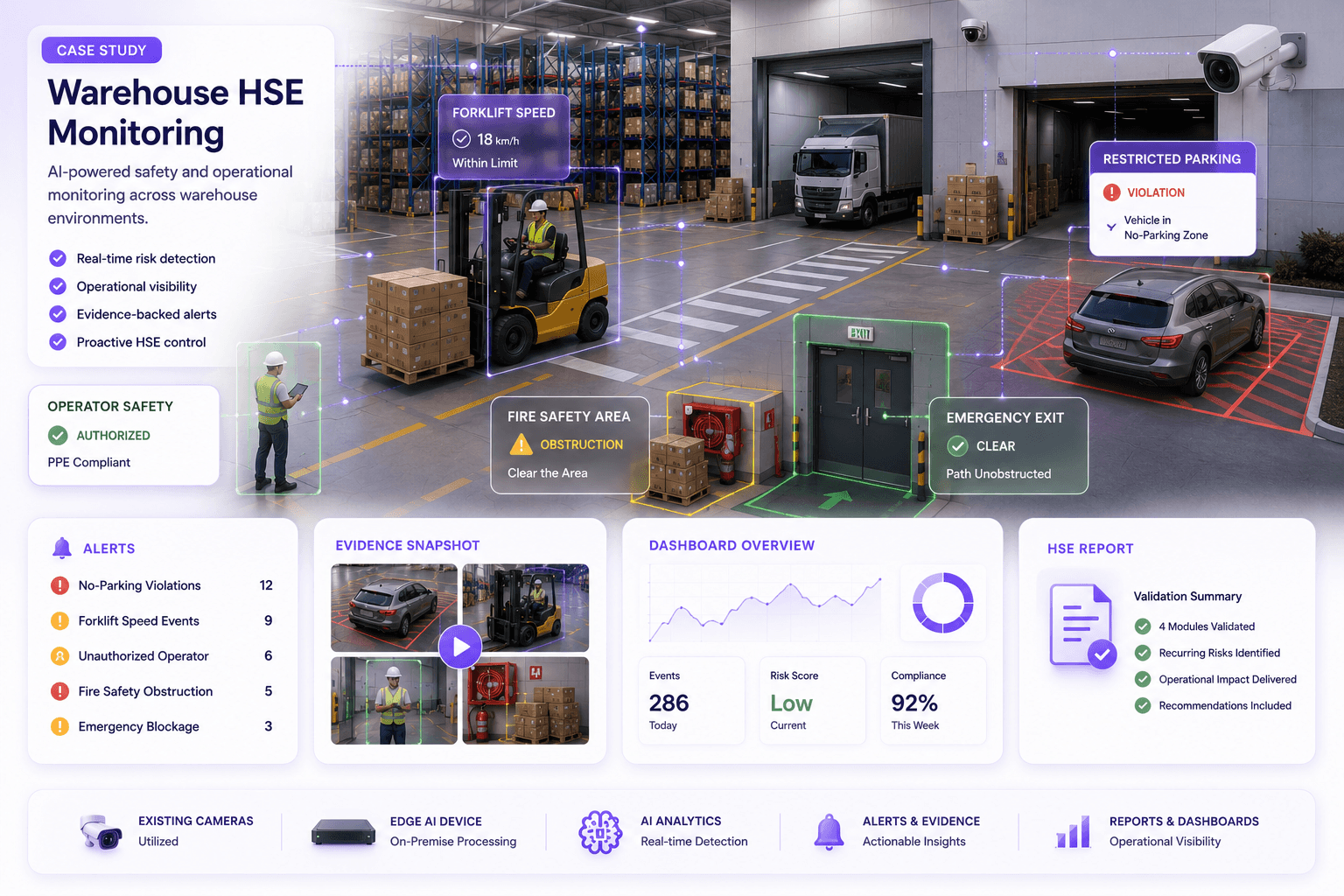
ParkGuard
Restricted zones
OperatorAssist
Operator control
SpeedGuard
Forklift speed
SafeGuard
Emergency access
Operational challenge
Warehouse risks often happen briefly, repeatedly and outside manual supervision.
The pilot focused on practical HSE scenarios that can create safety, movement and compliance risk during day-to-day warehouse activity.
Restricted parking and temporary obstruction can disrupt loading, movement and emergency access.
Forklift overspeeding is difficult to monitor consistently through manual supervision.
Unauthorized or unsafe operator activity can happen briefly and remain undocumented.
Emergency exits and fire safety equipment areas can become blocked during routine operations.
Modules validated
Four Omnivue modules validated across warehouse HSE workflows.
The pilot covered no-parking and restricted zones, operator compliance, forklift speed monitoring and emergency/fire safety obstruction detection.
ParkGuard
No-parking and restricted-zone monitoring
383
validated parking-related notifications
Validated for detecting vehicles and forklifts occupying no-parking or restricted operational zones beyond acceptable tolerance.
OperatorAssist
Operator control and unsafe equipment usage
17
operator-related notifications generated
Validated for unauthorized operator activity, operator-restricted machine zones and unsafe forklift usage scenarios.
SpeedGuard
Forklift overspeed monitoring
551
SpeedGuard notifications generated
Validated for identifying forklift movement above configured speed thresholds across operational warehouse zones.
SafeGuard
Emergency exit and fire safety obstruction
3,476
SafeGuard notifications generated
Validated for detecting blocked emergency exit paths and obstruction of fire safety equipment access areas.
Deployment approach
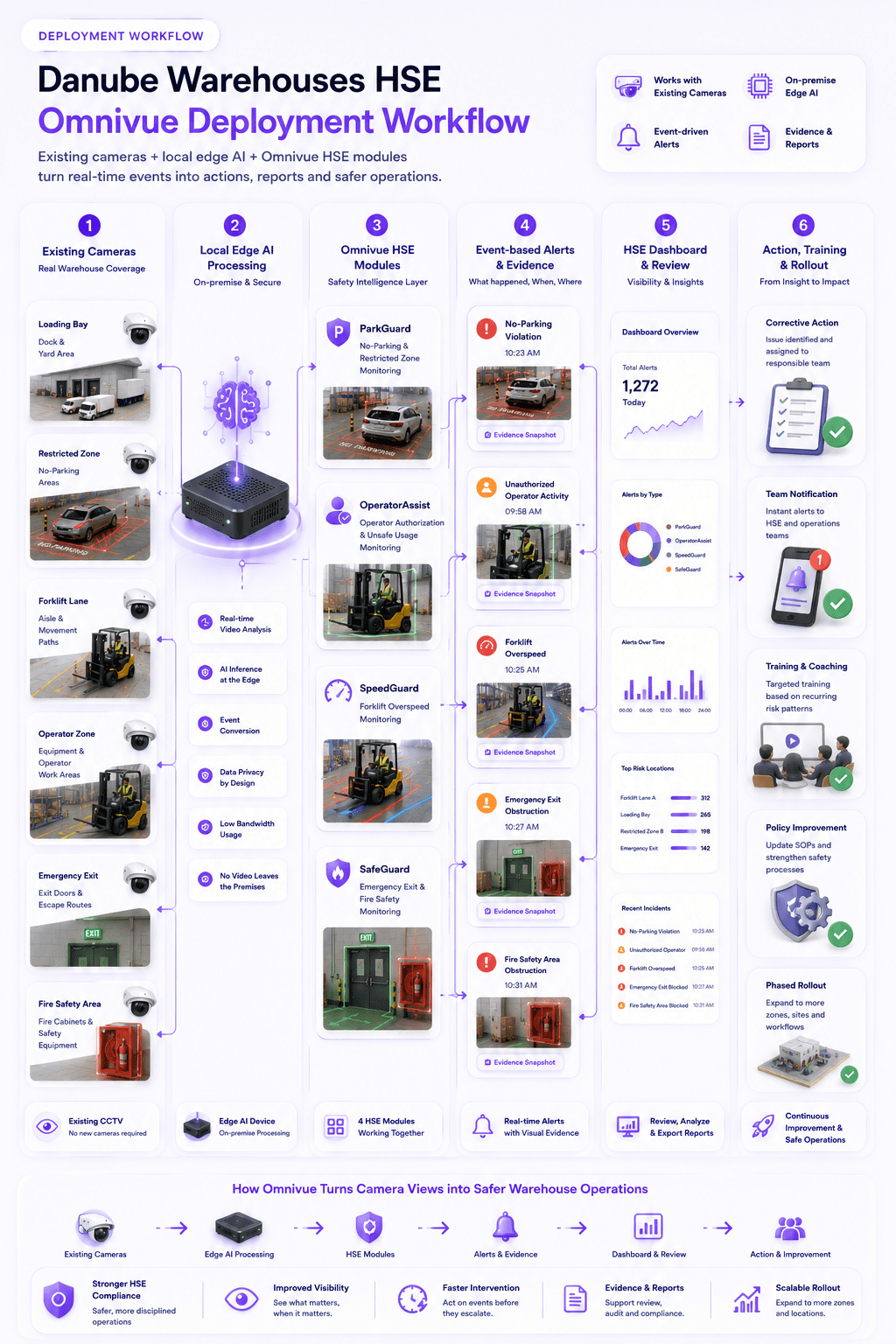
Existing cameras became safety workflows, not just video feeds.
Omnivue converted selected warehouse camera views into targeted monitoring zones, alerts, visual evidence, incident logs and HSE review workflows.
Step 1
Existing camera views selected
Relevant warehouse zones were mapped from existing camera coverage rather than replacing the full CCTV infrastructure.
Step 2
Safety-critical zones configured
No-parking areas, forklift routes, machine zones, emergency exits and fire safety areas were defined as monitored zones.
Step 3
Edge AI processed events locally
Omnivue processed video locally and converted qualifying conditions into structured alerts and evidence records.
Step 4
HSE teams gained event visibility
Detected violations were made reviewable through dashboards, incident logs and evidence snapshots.
HSE risks monitored
The pilot focused on recurring safety and compliance risks.
Each monitored risk was tied to a practical warehouse operation where real-time visibility and evidence can support faster review, intervention and corrective action.
No-parking and restricted-zone violations
Vehicles or forklifts occupying sensitive operational zones can create congestion, block access and reduce movement discipline.
Unauthorized or unsafe operator activity
Improper use of forklifts or machinery increases the risk of accidents, equipment damage and weak accountability.
Forklift overspeeding
Unsafe speed in aisles, yards or loading areas can increase collision risk and reduce stopping control.
Emergency and fire safety obstruction
Blocked emergency exits or fire safety areas create high-impact compliance and response-readiness risks.
Outcomes observed
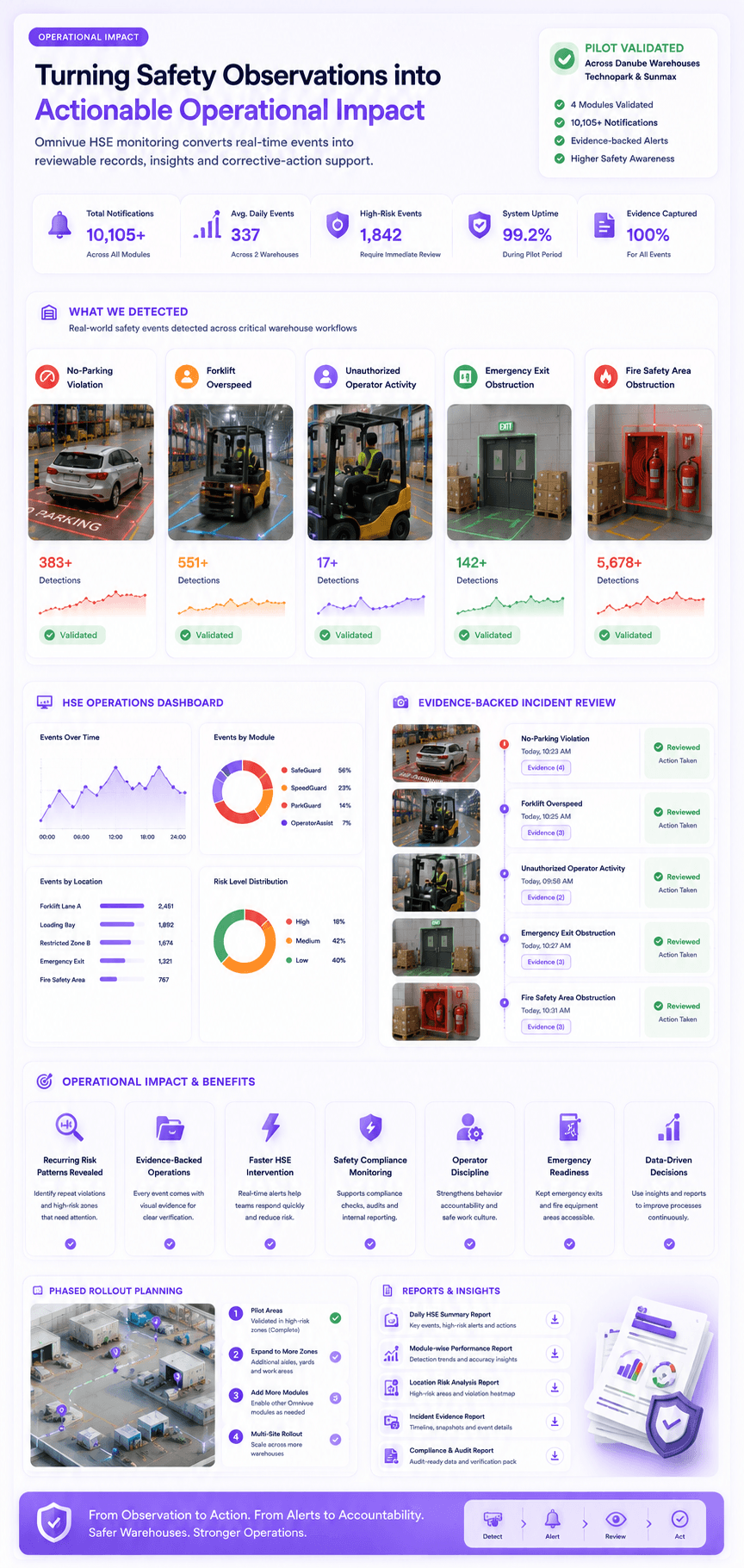
Omnivue helped turn HSE observations into evidence-backed operational records.
The pilot showed how continuous AI monitoring can support daily review, incident verification, training, accountability and phased expansion across additional warehouse zones.
Recurring risks became visible
The pilot surfaced repeated safety and operational behaviors that may not be consistently seen through manual supervision.
Evidence supported corrective action
Events were supported with visual evidence, helping HSE and operations teams review, verify and act on violations.
Safety compliance gained structure
The monitored workflows helped convert safety observations into repeatable, reviewable operational records.
Phased rollout became practical
The pilot demonstrated a repeatable model for expanding monitoring to additional high-risk zones and warehouse locations.
Detailed validation report
Public case study here. Detailed validation pack available on request.
The public page intentionally avoids publishing raw incident screenshots, full validation tables and sensitive internal site details. Qualified buyers and partners can request the detailed validation report for deeper review.
Pilot scope and location coverage
Module-wise validation summary
Safety use cases and configured monitoring zones
Notification and incident summary
Operational value observed during pilot
Deployment considerations and rollout recommendations
Best fit for
Warehouses, logistics yards, factories and industrial sites.
This deployment pattern is relevant wherever cameras already cover safety-critical zones, material movement, forklifts, emergency exits, fire safety areas and operator-controlled equipment.
Related Omnivue pages
Explore related solutions, industries and modules.
Want to validate similar HSE workflows at your site?
Share your warehouse layout, camera coverage and safety priorities. We can help map the right Omnivue modules and a focused pilot scope.