
Elevator safety awareness for residential building operations.
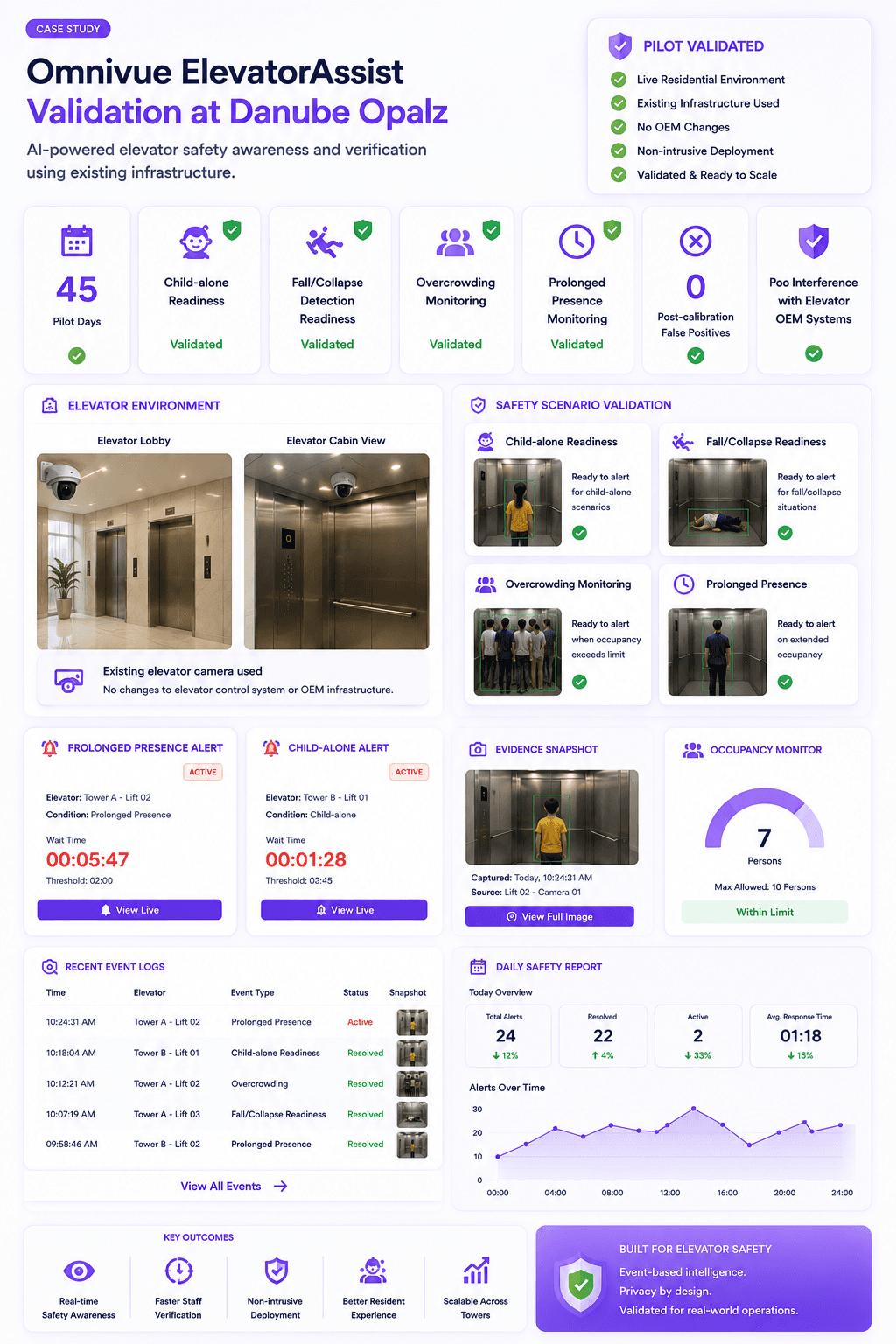
Omnivue ElevatorAssist was validated at Danube Opalz as a non-intrusive safety awareness layer for child-alone readiness, fall/collapse detection readiness, overcrowding and prolonged presence monitoring using existing elevator camera infrastructure.
45
pilot days
Live residential elevator validation
0
post-calibration false positives
After scenario tuning and threshold adjustment
No OEM changes
non-intrusive deployment
No interference with elevator control systems
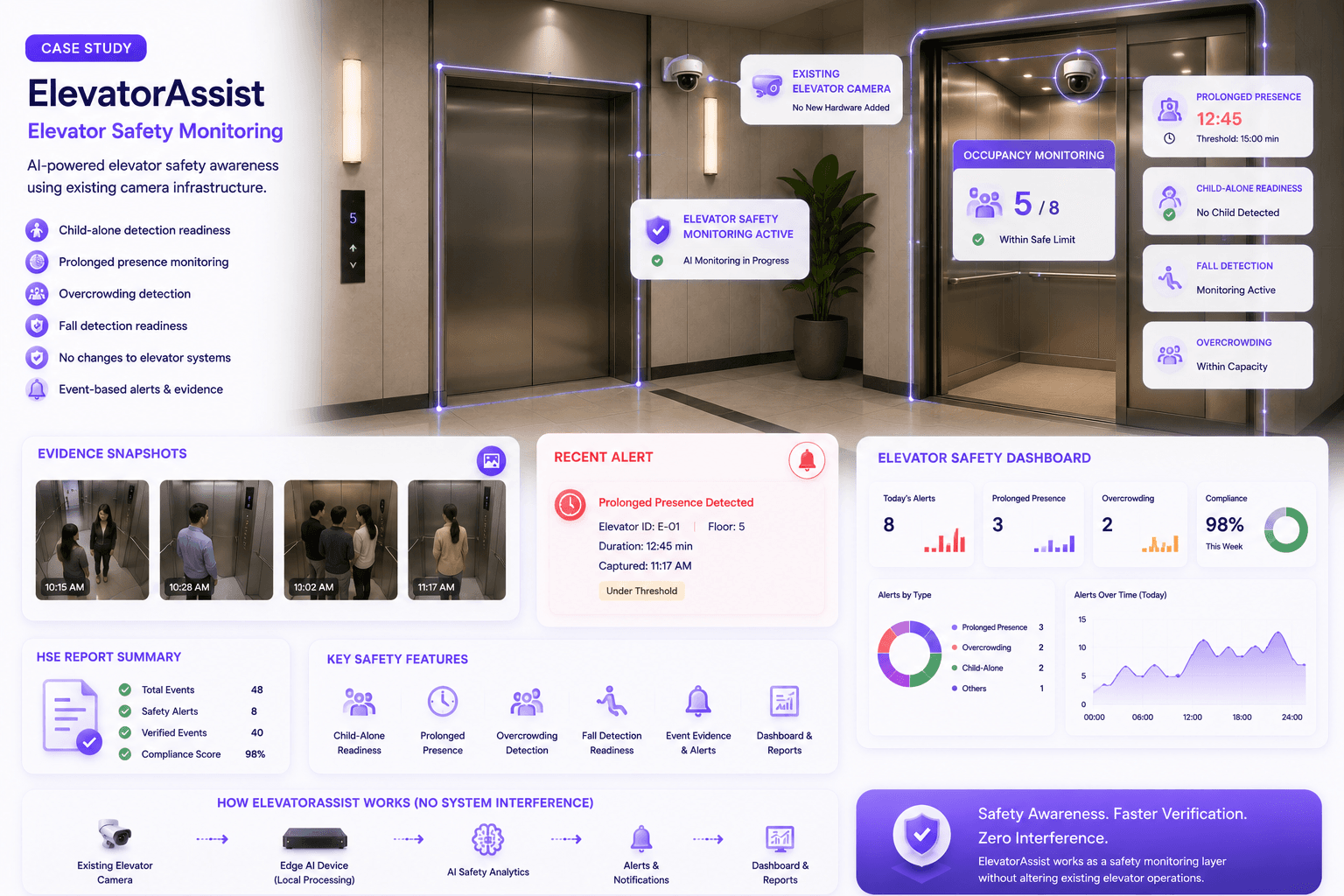
ElevatorAssist
Safety awareness
Existing Camera
No OEM changes
Edge AI
Local processing
Dashboard
Alerts and evidence
Operational challenge
Elevator safety incidents need faster awareness and easier verification.
Residential facility teams need a way to notice unusual elevator conditions sooner without replacing elevator controls or depending only on manual CCTV viewing.
Elevator incidents can remain unnoticed until a resident, visitor or guard manually reports the situation.
Children, elderly residents or visitors may require faster awareness when they are alone or stationary for too long.
Manual CCTV review is reactive and does not provide structured alerts for real-time verification.
Facility teams need safety visibility without modifying elevator control systems or interfering with OEM infrastructure.
Validation summary
ElevatorAssist validated multiple safety awareness scenarios.
The pilot focused on event-based awareness inside a live residential elevator environment, while keeping elevator controls and OEM systems untouched.
Child-alone readiness
ElevatorAssist was validated as a readiness layer for identifying child-alone scenarios that may require faster staff awareness.
Validated
pilot result
Fall/collapse detection readiness
The pilot validated fall/collapse detection readiness as an event-based safety awareness workflow inside the elevator environment.
Validated
pilot result
Overcrowding visibility
ElevatorAssist monitored occupancy conditions and overcrowding scenarios to support faster operational verification.
Validated
pilot result
Extended presence monitoring
The system monitored prolonged occupancy or extended presence conditions to surface situations requiring review.
Validated
pilot result
Deployment approach
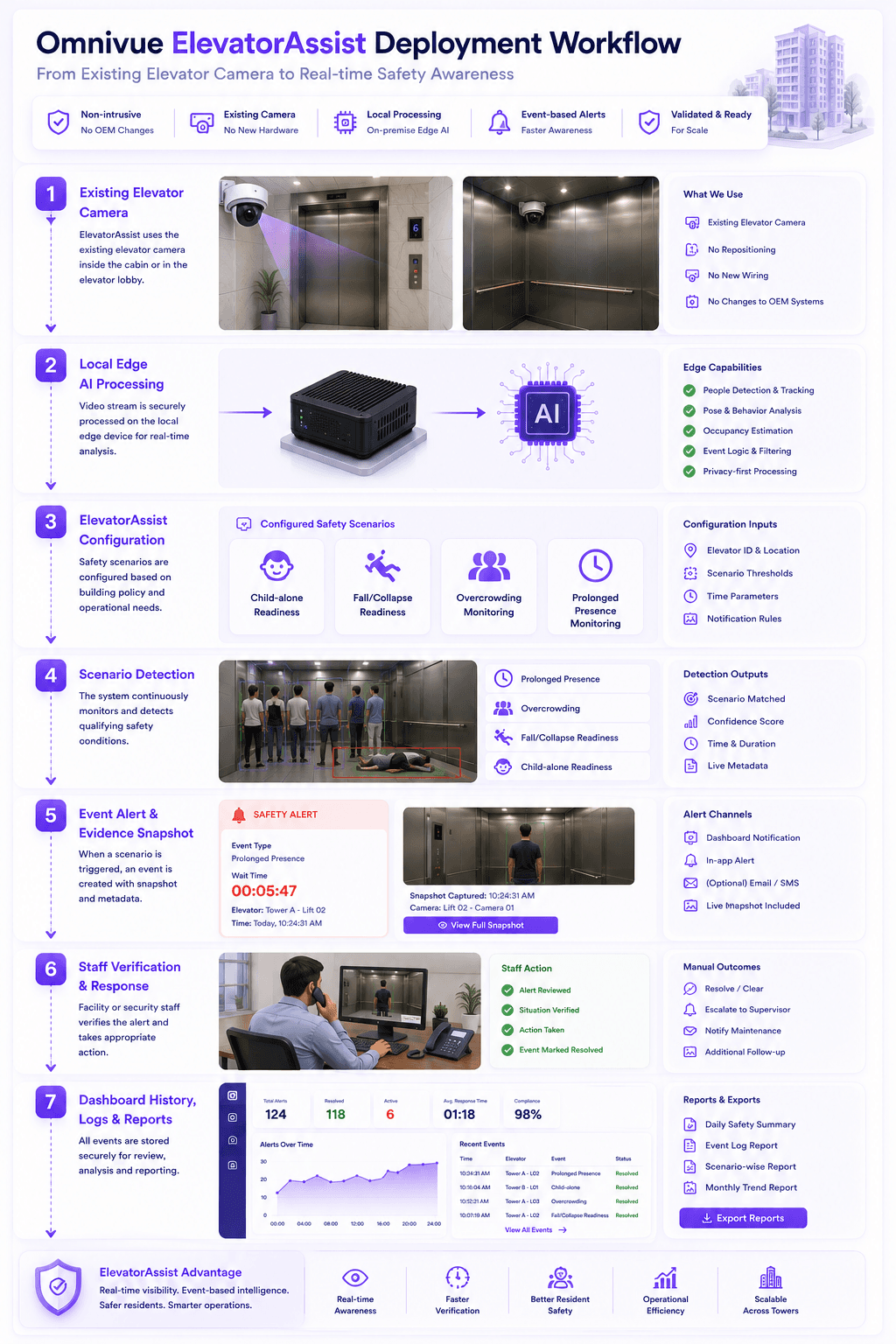
Existing elevator camera infrastructure became a safety awareness workflow.
ElevatorAssist was deployed as an AI monitoring layer over the existing elevator camera view, converting selected safety scenarios into alerts, evidence and reviewable records.
Step 1
Existing elevator camera used
ElevatorAssist used the available elevator camera view as the source for safety monitoring without replacing the elevator system.
Step 2
Local edge AI processing
Video analytics were processed locally through an Omnivue Edge deployment to create structured event records.
Step 3
Safety scenarios configured
Child-alone readiness, fall/collapse readiness, overcrowding and prolonged presence scenarios were configured and tuned.
Step 4
Alerts and evidence generated
Qualifying events were converted into alerts, evidence snapshots, dashboard visibility and reviewable records.
Use cases addressed
ElevatorAssist focused on safety awareness and faster verification.
The deployment was designed to help facility teams detect and verify unusual elevator conditions sooner, while staying non-intrusive to elevator control systems.
Child-alone readiness
Helps facility teams identify situations where a child appears alone inside the elevator and may require quick verification.
Fall or collapse readiness
Supports faster awareness of possible fall-like or collapse-like postures so staff can verify and respond.
Overcrowding detection
Surfaces occupancy conditions that may exceed configured safety or comfort thresholds during busy periods.
Prolonged presence monitoring
Identifies extended occupancy or unusual dwell situations that may indicate a stuck, delayed or unattended condition.
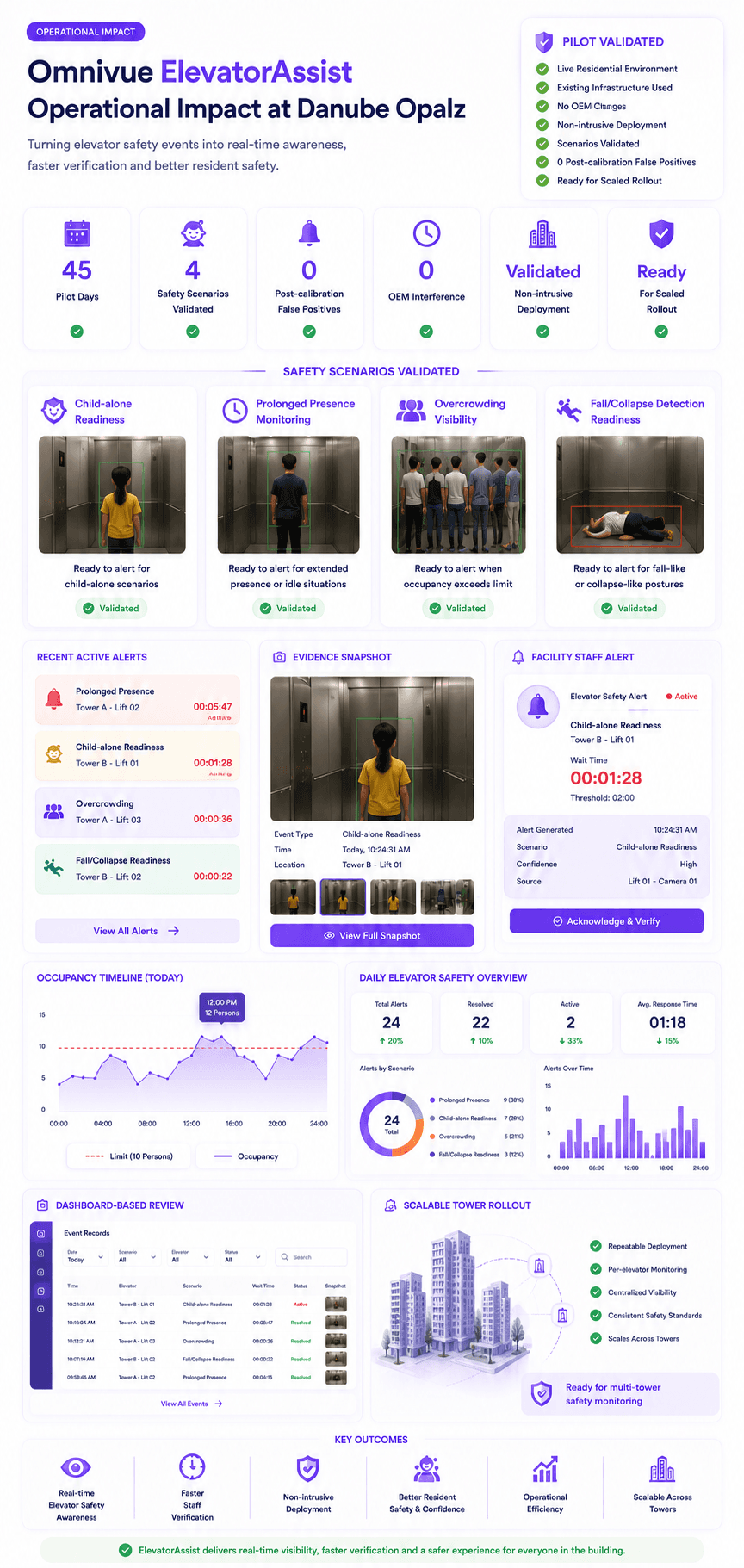
Operational impact
Elevator events became visible, reviewable and easier to verify.
The pilot demonstrated how an AI safety awareness layer can help facility teams verify elevator conditions faster without replacing cameras, changing elevator controls or disrupting daily operations.
Elevator safety became event-driven
Instead of relying only on manual CCTV viewing, the pilot converted selected safety conditions into reviewable events.
Faster verification became possible
Evidence snapshots and dashboard alerts supported quicker assessment by facility or security teams.
No interference with elevator systems
The deployment worked as a safety awareness layer without changing elevator OEM controls or daily elevator operations.
Repeatable model for residential towers
The pilot demonstrated a repeatable deployment model for elevator safety awareness across similar buildings.
Governance and boundaries
Designed as a safety awareness layer, not an elevator control replacement.
Awareness layer, not elevator control
ElevatorAssist is positioned as a monitoring and alerting layer. It does not control elevator movement, doors or OEM safety systems.
Event-based review
The workflow focuses on qualifying events, snapshots and dashboard review rather than publishing raw continuous video.
Local processing model
The system can operate on-premise through local edge processing, supporting privacy and operational governance.
Tuned for site conditions
Thresholds and detection settings can be tuned based on elevator camera angle, lighting, occupancy pattern and site policy.
Detailed validation report
Public case study here. Detailed pilot report available on request.
This public page avoids exposing raw elevator footage, sensitive building details, internal screenshots and private operational records. Qualified buyers and partners can request the detailed validation pack for deeper review.
Pilot location, deployment model and monitoring scope
Elevator camera usage and non-intrusive deployment approach
Safety scenarios configured and validated
False-positive observations and post-calibration tuning notes
Event-based alerting and evidence review model
Operational benefits observed during pilot
Limitations and recommended usage boundaries
Scaling considerations for additional elevators and towers
Best fit for
Residential towers, hospitals, campuses, hotels and managed facilities.
This deployment pattern is relevant wherever elevator safety visibility matters and existing camera infrastructure can support event-based monitoring.
Related Omnivue pages
Explore related solutions, industries and modules.
Want elevator safety awareness for your property?
Share your elevator camera coverage, building type and safety scenarios. We can help map a focused ElevatorAssist deployment for your site.